

In today’s environmentally and regulatory conscious environment, RECD (Retrofit Emission Control Device) solutions are becoming vital to diesel generator (DG) sets. Despite their increasing popularity, a few misconceptions hinder companies from adopting RECD in DG set systems effectively. Addressing these myths clearly is essential to promote understanding and encourage adoption.
Myth 1: RECD for DG Sets is Only For Large Industries
There is a common misconception, the belief that RECD devices are just needed for industrial, large-scale DG systems. In reality, emission standards can be applied to all industries, including hospitals, commercial buildings, and residential areas.
☘️ Modern RECD for DG sets solutions are highly scalable and can be adapted to small and medium-sized generators. Emphasizing this can help the audience feel assured that RECD benefits are accessible regardless of DG size, fostering confidence in its broad applicability.
Myth 2: RECD Significantly Reduces DG Performance
Many owners are concerned that installing an RECD may slow down engine performance or decrease effectiveness.
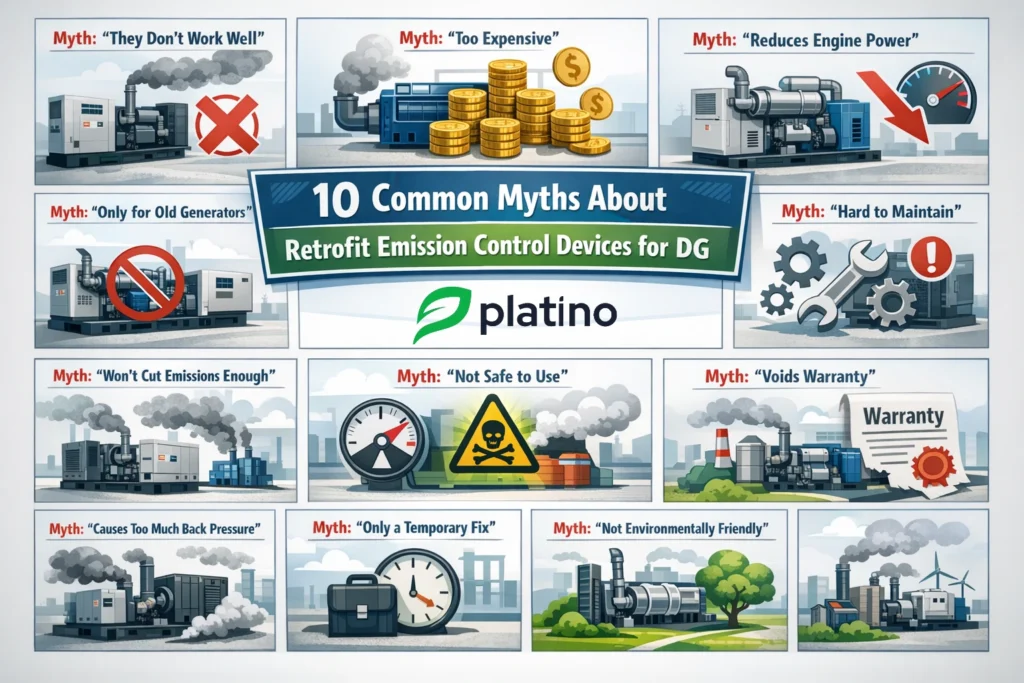
☘️ In reality, a well-designed RECD is engineered to ensure the best performance of the exhaust system. Advanced designs provide the least amount of backpressure to preserve engine efficiency, helping the audience feel reassured that emission reduction does not compromise performance.
Myth 3: RECD Is Too Expensive to Justify
Cost-related concerns are among the main obstacles. However, this misconception overlooks the long-term financial plan.
☘️ Although the initial investment in RECD in the DG set might seem substantial, it’s actually beneficial:
- Beware of regulatory penalties
- Enhance the value of compliance with the asset
- Increase brand recognition
As time passes, the ROI is evident, particularly in areas that have strict enforcement of pollution control.
Myth 4: RECD Installation Is Complicated
Another common belief is that the installation of RECD systems requires significant modifications.
☘️ In the real world, retrofit emission control devices are made to allow an easy connection to current DG sets. The majority of installations:
- Require minimal structural changes
- Can be completed in the time frame of a brief downtime
- Can be tailored to existing exhaust systems.
This makes adoption much simpler than most people think.
Myth 5: RECD Requires Constant Maintenance
Many users believe that RECD systems are costly to maintain and challenging to manage.
☘️ Modern RECD products are engineered to last longer and require fewer maintenance intervals. Routine inspections and periodic maintenance are enough to ensure maximum performance. When compared against the ecological and regulatory advantages, it is not necessary to maintain the equipment.
Myth 6: RECD Does Not Make a Significant Environmental Impact
This is a myth that undermines the primary function of RECD systems.
☘️ In fact, RECD for DG set can significantly lower particulate emissions as well as harmful pollutant emissions, which contribute to:
- Better air quality
- Lower health risks
- Environmental standards are being met.
In urban areas such as Chennai, in which DG use is very significant, this effect is particularly significant.
Myth 7: Only New DG Sets Need Emission Control
Many people believe that emission control is only required in newly installed generators.
☘️ However, more and more regulations require retrofit options for existing DG sets. This is the point where RECD plays an important role, allowing older generators to be compliant with current emission standards, without having to complete replacement.
Myth 8: RECD Systems Are Not Durable
Problems with durability often result from a lack of understanding.
☘️ high quality RECD systems are made with robust materials specifically made to withstand extreme temperatures and constant operation. When properly installed and maintained, they provide maintenance, longevity in service, and constant performance.
Myth 9: RECD Is Not Mandatory
Some companies believe that the emission control option is not necessary.
☘️ In reality, pollution control authorities across the country have set up RECD for DG-enforced compliance, especially for certain capacities. Failure to comply can lead to:
- Fines
- Operational restrictions
- Legal complications
It is crucial to know the local regulations to reduce the risk.
Myth 10: RECD Offers No Business Advantage
The last Myth is that RECD is purely a compliance burden.
☘️ Forward-thinking businesses acknowledge that RECD implementation can improve their sustainability position. It could:
- Improve ESG (Environmental, Social, Governance) scores
- Improve brand trust
- Green certifications are a must.
In a competitive market, environmental responsibility can be an important strategic benefit and not just a necessity.
Why RECD Is a Smart Investment 💡
Beyond dispelling the myths, it is important to know the overall value concept of RECD systems:
- Regulation Compliance: Stay aligned with the ever-changing emission standards
- Health and Safety: Limit exposure to pollutants that cause harm
- Operational Continuity: Beware of shutdowns caused by non-compliance
- Sustainability Goals: Contribute to cleaner energy practices
As standards for emissions increase, the importance of RECD’s role in DG will grow.
Conclusion
Misconceptions around RECD systems usually stem from outdated information or a lack of technical understanding. In reality, RECD systems are effective and practical, and essential for modern DG operations.
Businesses that proactively adopt RECD for DG set ot only to ensure compliance but also position themselves as responsible contributors to environmental sustainability. As the challenges of urban air quality grow, retrofitting technology to control emissions is no longer an option; it’s a necessity. 🌍
